
Inside Creative Roots Landscaping’s people-first approach to creating better meetings and stronger teams that build trust, clarity, and accountability.
Why Better Meetings Build Stronger Teams
Early in my career I thought the best way to improve the business was to work harder in the field. If we just pushed a little faster, added a few more jobs, or raised the quality bar another notch, things would get better. But what I’ve learned since is that better meetings build stronger teams, and that’s what really moves the business forward.
To a certain extent, that was true. Hard work moves the needle. But it’s also a tough way to run a business when you’re trying to grow beyond what a single owner can control.
Eventually, I realized that real breakthroughs happen when we stop working for a minute and start talking. Openly, honestly, and often. That’s what our huddles are for.
They’re where we connect the dots between the numbers and the work. They help people understand how the business really runs and make sure what gets talked about actually gets done.
They’re also where we connect the things we do every day as humans to the results we all share — profit, cash, or sometimes the lack of either.
In a nutshell, it’s where we talk business with the people we’re in business with. And because of that, huddles have become one of the most valuable habits we have. If you’ve ever wondered what that really looks like in practice, I wrote more about it here — how we teach financial literacy and make the numbers part of everyday conversation.
In an open-book company, meetings aren’t just updates. They’re classrooms. They’re also mirrors that show us where we’re strong, where we’re struggling, and where we need to step up together.
Meetings as a Reflection of Culture
For the first decade in business, I’m not sure I thought of meetings as a waste of time. I just didn’t think of them as a craft.
Then, about twenty years ago, I read Mastering the Rockefeller Habits and decided to give weekly meetings a real shot. It was a bit awkward at first, probably for everyone. But like anything worth learning, we stuck with it. And as surely as we got good at mowing lawns, laying pavers, and running machinery, we got better at communication.
Looking back, those early meetings taught us that leadership isn’t just about directing traffic; it’s about inspiring others to follow. It’s about helping people connect their daily work to the bigger picture. When that connection clicks, engagement follows. Over time, I realized that better meetings lead to stronger teams, regardless of the business’s size.
At Creative Roots Landscaping, meetings are not about control or hierarchy; they are about collaboration and mutual growth. They’re about clarity, connection, and follow-through. When people understand what’s going on and can influence it, they care more and act like owners.
The Rhythm of Our Company-Wide Huddle
Our company-wide huddle takes place once a month, on the second Tuesday at 3:00 p.m. The consistency matters. People plan for it and show up ready.
We always have food, the universal language of landscapers. Sharing a meal breaks down barriers, opens up conversation, and reminds us that we’re all part of the same team.
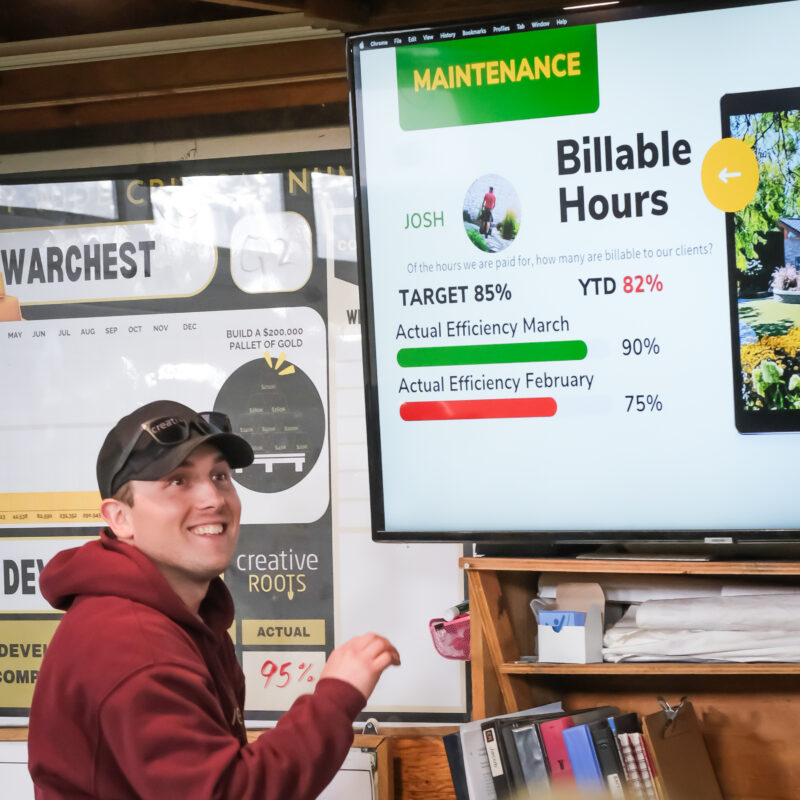
Each meeting begins with a brief icebreaker to encourage conversation. We then review actuals to date and forecast for the coming months using a condensed P&L scoreboard. It’s simple, visual, and focused on what people can influence.
We review our company-wide Driver Board to ensure that what gets discussed gets done. We review key measures that move the needle toward what we’ve defined as winning — things like revenue per hour, employee satisfaction, employee journey and development, business development, client journey, billable hours, and other role-specific behaviors that, when acted on, create results.
The goal isn’t to admire the numbers. It’s to choose actions that improve them.
We finish by making clear commitments — who will do what, by when, and how we’ll know it’s done. Every meeting ends with appreciations. A simple thank you changes the tone of the whole room and reinforces the behaviors we want to see again.
From Awkward Beginnings to Ownership
I still remember those early meetings when we were trying to figure out what effective even looked like. We didn’t have a scoreboard or a rhythm, just a group of people trying to make things work.
However, over time, something began to shift. Communication became sharper. People started asking better questions. They began to see how their actions impacted the company’s outcomes.
That evolution — from awkward to effective — showed me that good meetings aren’t about charisma or presentation. They’re about persistence. Practice enough, and you build muscles for listening, accountability, and collaboration.
The real magic is when people start to see that the numbers on the board aren’t management’s numbers. They’re ours. That’s when ownership takes root.
How Weekly Huddles Create Stronger Teams
Outside of the monthly company-wide huddle, smaller teams run shorter weekly huddles around a whiteboard. The format is similar but tighter — what we learned, where we’re off, and what small move will help today.
The cadence keeps communication alive and connects daily choices to company goals. It also creates a sense of rhythm and predictability, two underrated ingredients of trust.
How to Know if a Huddle Is Working
Like anything worth doing, huddles take practice. Over time, I’ve learned that a great meeting isn’t defined by how polished it looks, but by how it feels when people walk out of the room.
We often use a simple Huddle Assessment to keep ourselves honest. It’s a quick pulse check to ensure we’re staying true to what matters: showing up prepared, discussing the right numbers, being candid about wins and losses, and leaving with clear commitments and energy to act.
If you want to know whether your huddles are hitting the mark, ask yourself:
-
Do people arrive on time and prepared?
-
Are conversations centered on the numbers that drive the business?
-
Are we looking forward, not backward?
-
Are wins and losses shared openly?
-
Does everyone leave knowing what success looks like — and what to do next?
You don’t have to score it or make it formal, but regular reflection helps keep the rhythm healthy and grounded in purpose.
Why This Works
Culture isn’t built at a retreat. It’s built one conversation at a time. Meetings are where we align on reality, decide on actions, and hold each other accountable for the promises we make.
When people understand the business and feel respected enough to participate in it, things tend to get better. Not all at once, and not perfectly, but better. Progress is evident in the way people interact with one another, their approach to challenges, and their ownership of the results.
We still have our share of issues — missed commitments, messy conversations, and plenty of things we’re working on. But even those moments matter. They remind us that this is a practice, not a finished product.
Over time I’ve come to see that the real art of meetings lies in balance — between structure and spontaneity, accountability and empathy, data and story. When those pieces start to come together, something shifts. People begin to see that they have a stake in the outcome. Better meetings build stronger teams, and stronger teams build better companies.
At the end of the day, better meetings, stronger teams aren’t just a slogan — it’s a daily practice. The more we show up, talk openly, and learn together, the stronger we all become.
You might also like:
- Open Book Management: Connecting Your People With Profits
- With every set of hands, I get a free brain! – OBM from an employee’s perspective
- Beyond the Daily Grind: Building a Business That Thrives Without You!