
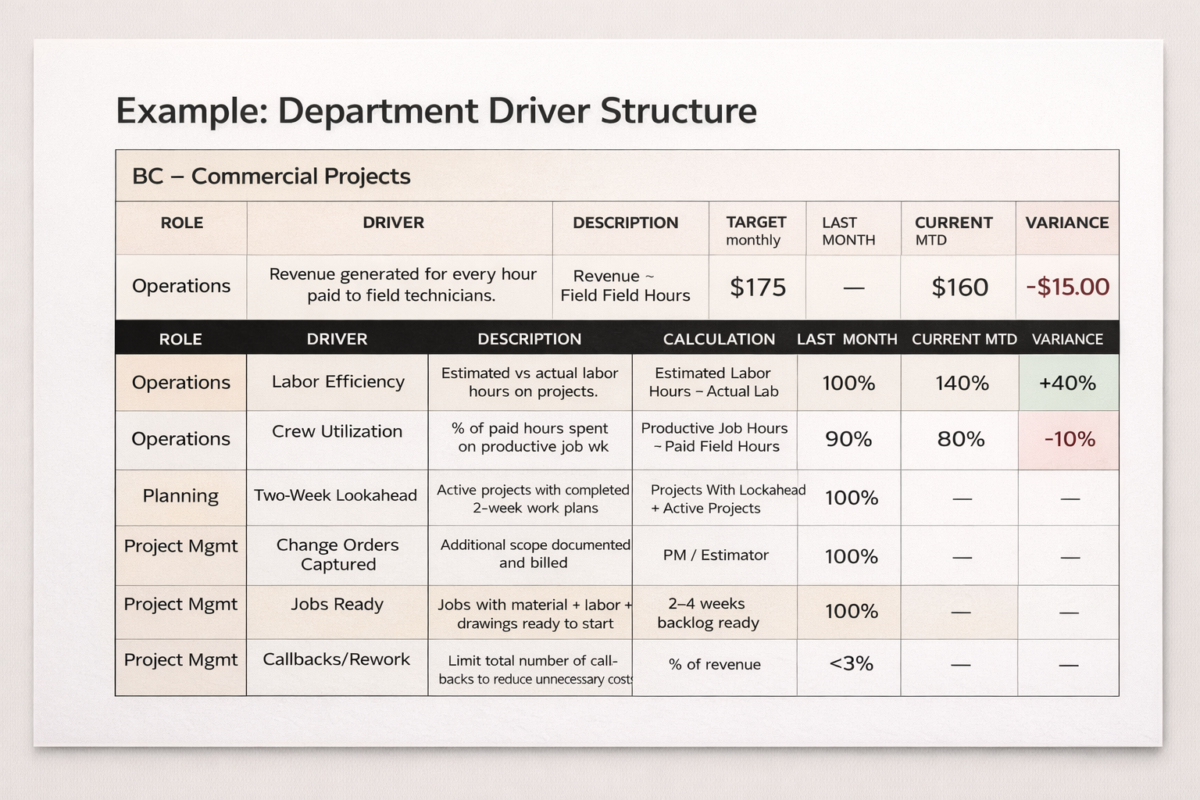
In the last few weeks, I’ve been having a lot of conversations with business owners about how difficult it can be to choose the right drivers, and more importantly, how to connect them to people’s day-to-day actions.
Whether you call them KPIs, metrics, or drivers, I prefer to use the word drivers, because that’s what they should be doing. They should be driving behavior.
Getting these right won’t make or break a business overnight, but they shine a light on the things that actually produce better outcomes more than almost anything else we track.
Remember that more often than not, what gets measured, and what gets talked about, gets done.
Most companies don’t have a driver problem. They have a thinking problem!
They are tracking numbers. In many cases, a lot of them. But when results don’t improve, the instinct is to add more tracking or refine the existing KPIs.
The issue is not a lack of measurement. The issue is that many of the numbers being tracked are outcomes, not levers.
Revenue per hour, billable efficiency, hours versus budget, output per crew. These are all important. But on their own, they don’t tell your team what to do differently tomorrow morning. They simply tell you what already happened.
That distinction matters more than most people think.
Over the years, what I’ve found works better is to simplify how we think about drivers and be much more intentional about how they are chosen and used.
At the highest level, every role in a company exists to do one of three things. It either produces revenue, protects profit, or increases the capacity of others to do both. If a driver doesn’t clearly connect to one of those, it’s probably not worth tracking.
The Three Layers of a Useful Driver System
First, there is a primary driver. This is the clearest signal that a department or team is winning. In a landscape company, that might be revenue per hour or gross margin. In another industry, it could be something entirely different, but the idea is the same. It is a single number that reflects performance at a meaningful level.
Second, there are supporting drivers. These are the behaviors that actually influence the primary number. This is where most companies fall short. If revenue per hour is the primary driver, then the real work is in the things that move it. Billable efficiency, starting jobs on time, having materials ready the day before, and reducing rework are all examples of drivers that people can actually act on.
Third, there are guardrails. These exist because it is entirely possible to improve a number and still make the business worse. You can push revenue per hour up and damage margin. You can increase output and hurt quality. Guardrails like gross margin, customer experience, safety, and rework help keep things balanced.
Departments Own Outcomes. People Own Drivers.
At a department level, outcome-based drivers make sense. A maintenance division or an install division can own something like revenue per hour or gross margin because those results are influenced by the collective effort of the team.
At an individual level, those same drivers often become less useful. A crew member does not control pricing, job mix, or scheduling gaps. A project manager does not control who was hired or how well the warehouse prepared a job.
When you assign outcome-based drivers directly to individuals, you create frustration because the number is only partially in their control.
A better approach is to let departments own the outcomes and have individuals own the drivers that influence those outcomes.
Using a simple example, if an install department is focused on revenue per hour, that remains the primary driver at the department level. But when you break it down, different roles influence it in different ways.
A project manager might be responsible for planning and capturing change orders.
A crew lead might focus on efficiency and starting jobs on time.
A crew member might focus on productive time and minimizing rework.
The warehouse might focus on job readiness.
Now you have alignment without forcing everyone to own the same number.
When everyone owns the same number, no one owns the result.
Why Focusing on Operations First Often Misses the Point
The assumption is that if the field improves, the business improves. Sometimes that is true, but just as often the real constraint sits somewhere else.
Hiring, scheduling, planning, materials, communication. These are not always seen as “production,” but they have a direct impact on how well production performs.
When you step back and look at it differently, support roles are not secondary. They are enabling roles. They create capacity, clarity, and consistency.
Without those three things, operations will struggle regardless of how capable the people are.
There is one more layer that matters. It has to do with time.
Some drivers will stay with you for years. They are foundational and continue to matter as the business grows. But many drivers should change depending on what the business needs most right now.
At any given time, there is usually a constraint. A weakness that needs to be addressed or an opportunity that should be taken advantage of.
In open-book management, this is often referred to as the critical number. I tend to think of it as the current focus for the next six to twelve months.
Once that focus is clear, the question becomes which drivers will move it the fastest.
If the focus is on improving cash, then billing speed, accounts receivable days, change order turnaround, and job completion timing may become the priority drivers.
If the focus shifts to improving revenue per hour, then efficiency, scheduling, job readiness, and rework might take priority again.
The business hasn’t changed, but the emphasis has.
If your drivers don’t change when your focus changes, people can stay busy without actually moving the business forward in a meaningful way.
When they do change, the opposite tends to happen. People start to understand how their role connects to results, and decision-making improves at every level.
Drivers only work when people are part of the game.
You can choose the right drivers. You can explain them clearly. You can build a clean scoreboard. And still get very little change.
Because understanding is not the same as ownership.
Drivers start to matter when people are part of the process, not just on the receiving end of it.
That doesn’t mean everyone sits in a boardroom building spreadsheets, but it does mean people can follow the numbers, keep score, ask questions, and see how their actions connect.
When that happens, something shifts. The numbers stop feeling like management tools and start feeling like a game the team is playing together.
This is where High Involvement Planning and Open-Book Thinking become practical, not theoretical.
When people participate, they understand how the numbers are created. They begin to think in terms of cause and effect. They catch problems earlier. They make better day-to-day decisions. And they care more.
If people don’t participate, they don’t buy in. If they don’t buy in, they don’t commit. If they don’t commit, they don’t execute.
You can feel that in any business.
When people are disconnected, you spend your time pushing. When people are involved, things start to move without as much effort.
It also changes the experience of running the company. You’re not the only one thinking about the numbers. You’re not the only one trying to solve problems. You’re not the only one carrying the weight.
It becomes less lonely.
Over time, you end up with a team that understands the business, speaks the language, sees how their role fits, and is capable of improving it.
At that point, drivers are no longer just something you track.
They become something your team uses.
Most profit problems aren’t math problems. They’re visibility and thinking problems.
When people understand what matters, what drives it, and how their role connects to it, performance tends to follow.
And when that happens, the business improves in a way that’s a lot less forced and a lot more sustainable.
About me
I have spent over 30 years in business, from working in the field to leading a company and mentoring other owners. Through that experience, I’ve learned that true business success doesn’t come from working harder. It comes from building a company that operates as an asset, not just a job.
If you’re looking for ways to transition from working in your business to building an ownership-driven company, let’s talk.
 Book a Free Strategy Call to learn how Open-Book Management and structured leadership development can help you build a business that thrives—whether you’re there or not.